Services
Video surveillance
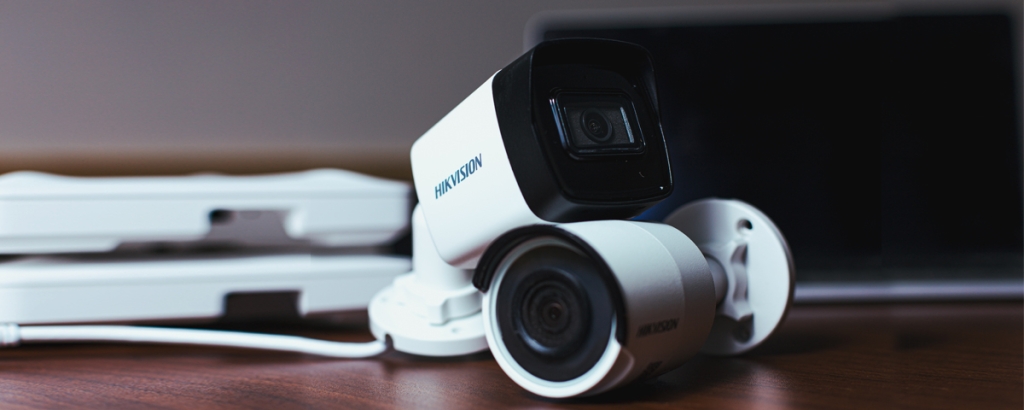
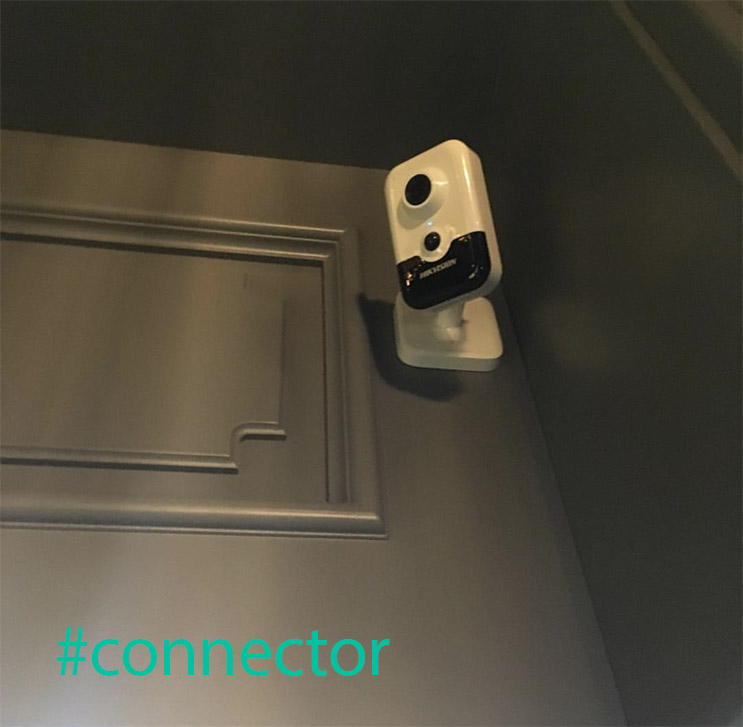
The IT specialist team at #connector has been performing “turnkey” video surveillance system installations since 2009.
Modern video surveillance systems are essentially local area networks where every device has its own IP address. Therefore, during installation, it is crucial to understand network architecture and how the surveillance system will impact the existing local network. It is equally important to account for the quality of connection waterproofing, the reliability of component mounting, and the correct choice of system architecture to ensure an even distribution of video stream loads across the network.
While there are many firms in Uzbekistan involved in video surveillance, there are very few skilled engineers who consider every nuance. Consequently, more complex surveillance systems should not be entrusted to “budget” installers or narrow specialists (“camera-men”).
To support these operations, we have a technical department (see Company Structure) that handles surveying, design (see Design), and installation work.
Since 2009, we have completed several thousand video surveillance installation projects of various types. We have gained immense professional experience, allowing us to perform installations that account for all the nuances of subsequent system operation. After our installation, everything will work for you!
A person who has dedicated their career to a specific profession and achieved a high level of qualification, skill, and experience is called a professional. To ensure that all work is performed to a high standard and that the system functions for many years, we recommend entrusting all installation work to professionals with years of experience.
Cameras
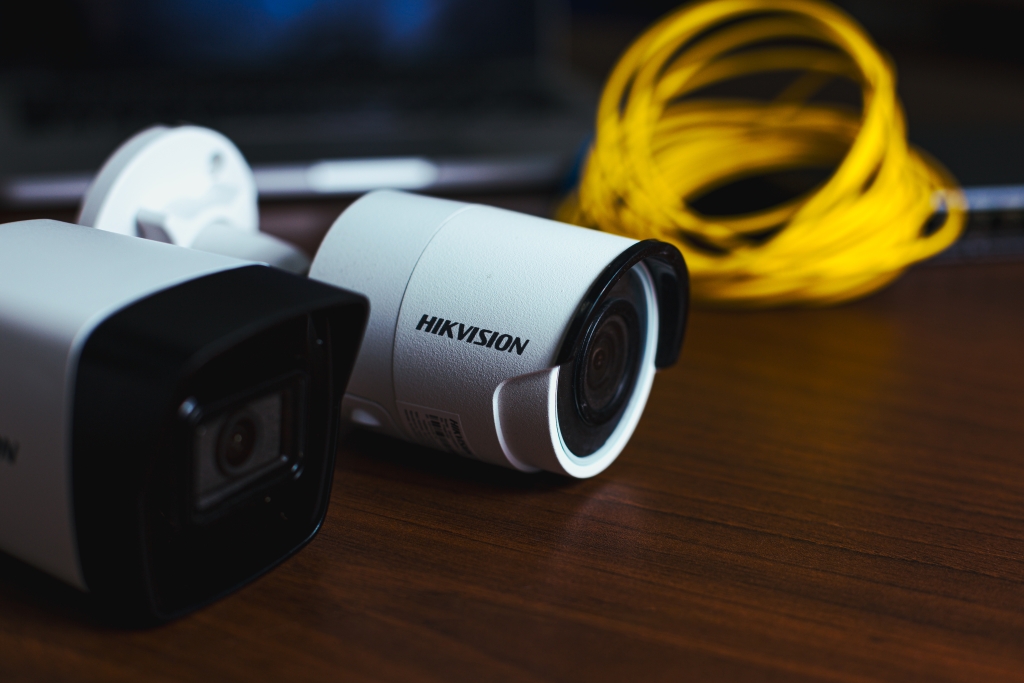
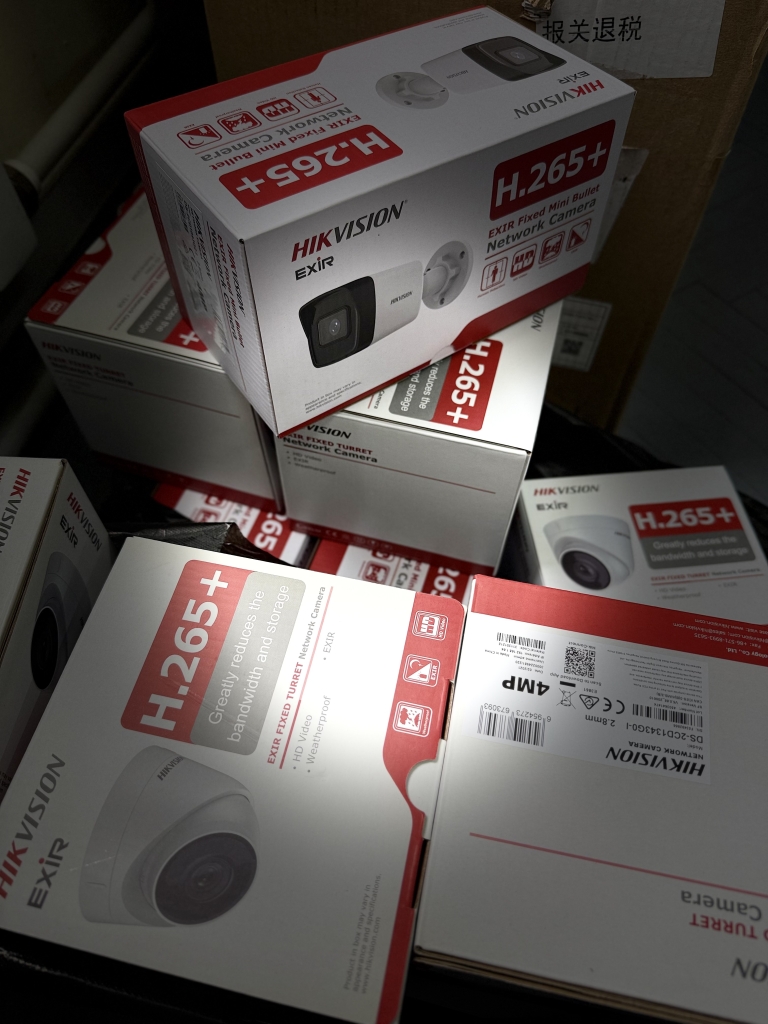
We use only high-quality digital IP cameras from the world’s leading brands. Currently, these are Hikvision and Dahua. A huge range is always in stock in Tashkent. Upon request, we can also work with cameras from other manufacturers.
Cameras are classified according to several main characteristics:
By housing type
- Dome — compact, inconspicuous. It is difficult to throw a cloth or fabric over such a camera. Due to the dome, it is hard to tell which direction the camera is facing. Generally used indoors, in offices, and shopping centers. Average cost. High reliability.
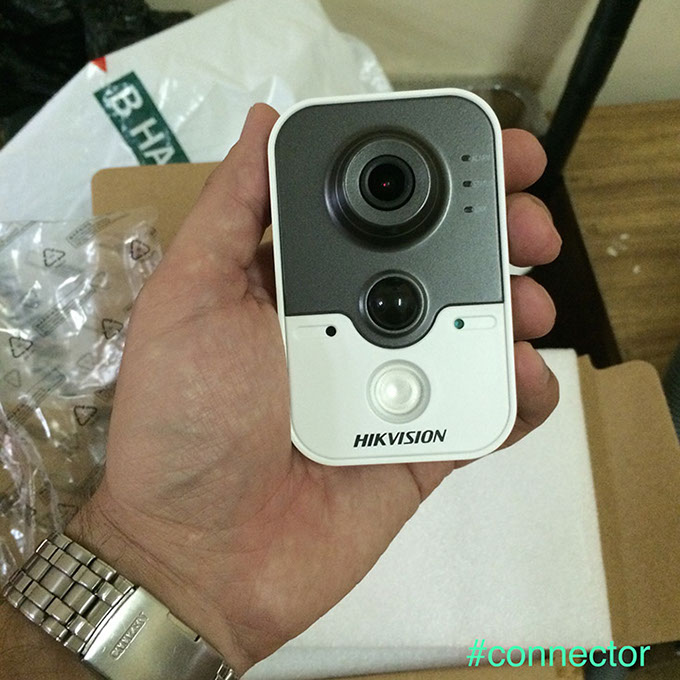
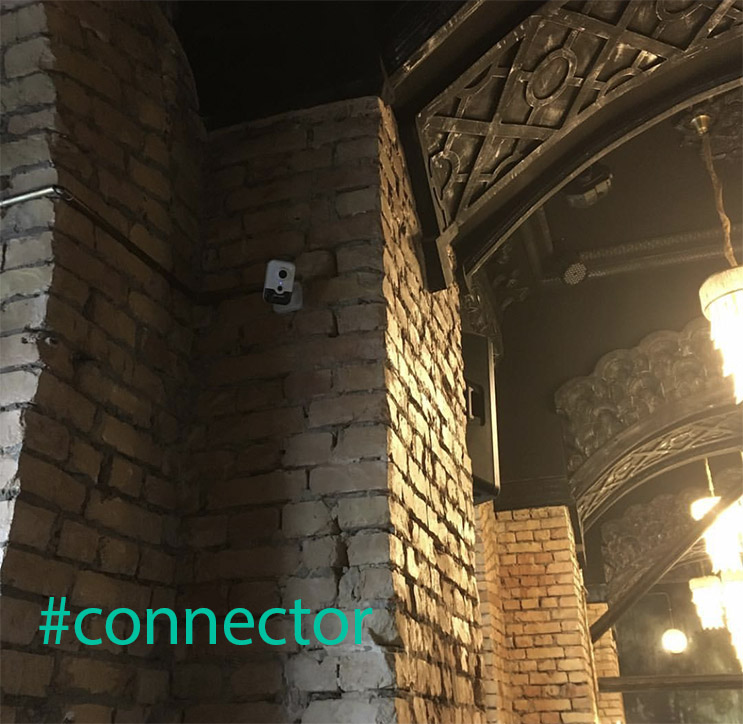
- “Cigarette pack” housing cameras got their name due to their compact size and rectangular shape resembling a pack of cigarettes. They are used where inconspicuousness and neat integration into the interior are important. As a rule, they have a high-quality built-in microphone and a wide viewing angle. Well-suited for use at cash registers, bars, retail outlets, and meeting rooms where people communicate. Average cost with good reliability.
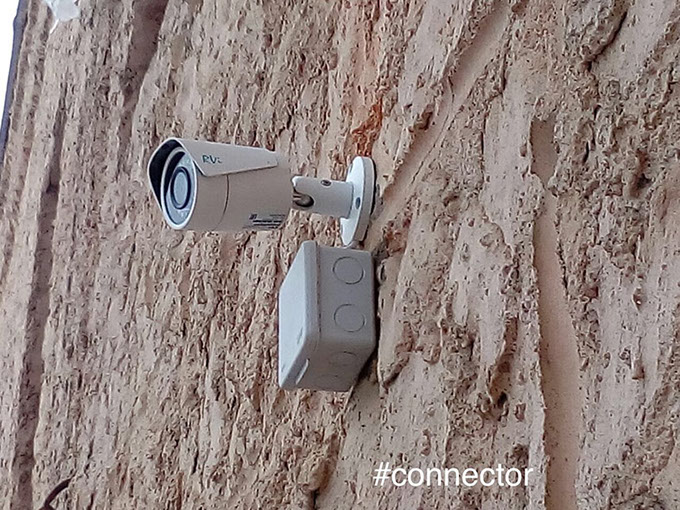
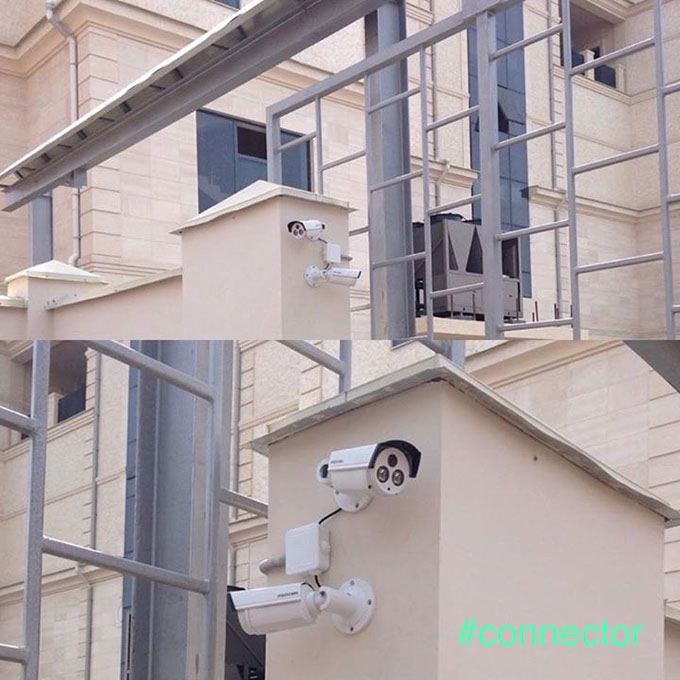
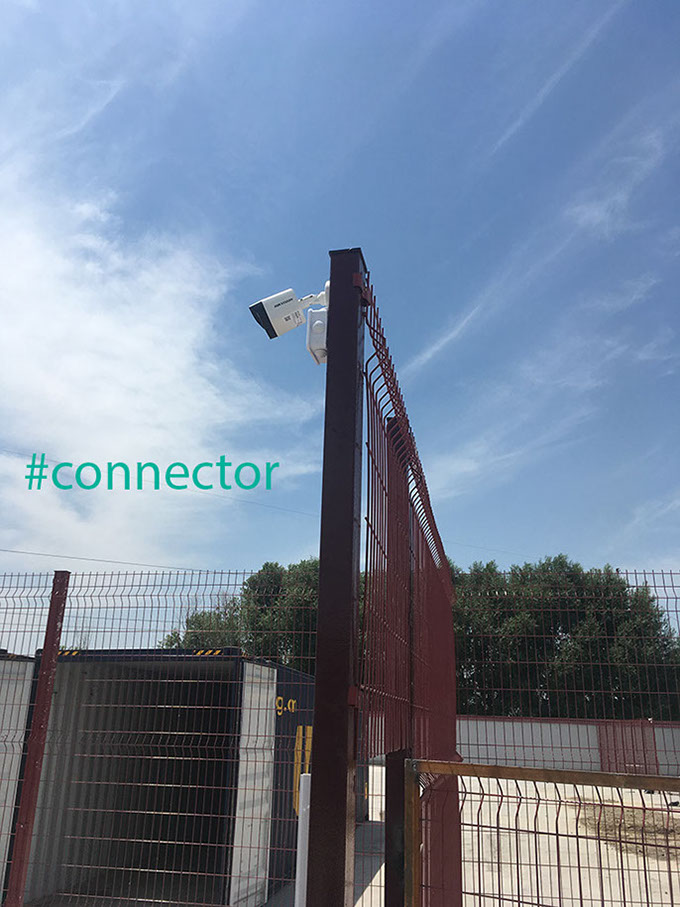
- Cylindrical (bullet) and rectangular — clearly visible, creating a “visual control” effect, popular for outdoor surveillance. Usually in an all-weather sealed design. The most popular housing type, can be used in almost all fields. Low cost. High reliability.
- Speed Dome (PTZ) cameras are robotic devices that can rotate $360^\circ$, tilt, and zoom. They are designed for dynamic monitoring of large territories. Convenient to install on tower cranes and high-rise buildings. High cost. Since these cameras contain a lot of mechanics, their reliability is lower than that of stationary cameras.
By lens
- Fixed — the focal length of the lens is unchangeable (short — wide angle, long — narrow angle). Focal length is measured in millimeters. For example, if the camera specifications state a focal length of 2.8 mm, it means the viewing angle is 106°. When selecting cameras, we choose the required focal length. A simple, reliable solution for monitoring a specific zone.
- Varifocal — allows for changing the viewing angle and focal length. This is known as optical zoom with various magnification levels. For example, it is used in Speed Dome (PTZ) cameras.
By functionality
- Day/night — almost all cameras have an operation mode for darkness. Visibility in the dark is provided by infrared (IR) illumination. The image becomes black and white at night. There are cameras with additional lighting (resembling a standard flashlight); in this case, the image at night will be in color within the range of such lighting. The illumination light will be visible, and the frames per second (FPS) will be lower than in daylight and lower than with IR illumination at night.
- Wi-Fi cameras — wireless solutions for convenient installation. A wire will still be required to power the camera. However, the data transfer speed via Wi-Fi will be lower. Additionally, the wireless network will be strained by transmitting the video stream over the air. It is recommended to install such cameras only in exceptional cases, such as in elevators.
- With audio — there are camera models with built-in microphones. There are also models with both microphones and speakers for two-way communication. Such cameras are well-suited for use at cash registers, storefronts, retail outlets, and meeting rooms where people communicate.
- With video analytics — support for facial recognition, people counting, and behavior analysis. Special software is required for full functionality.
- Power — almost all modern IP cameras support two power options: 12V DC and PoE (Power over Ethernet) at 48V. PoE is a technology that allows power and data to be transmitted over a single network cable. It is recommended to use the PoE option; there is less voltage drop over distance, the installation is more convenient and neater, and it allows for centralized power for all cameras from a PoE switch.
- By resolution — budget 1–2 MP (HD, Full HD) for homes and small offices; the medium and most popular option of 3–5 MP for warehouses and retail outlets; high resolution 6–8 MP (4K) for business centers and parking lots; and the premium segment of 12–20 MP for stadiums and airports.
Video recorders (NVR) and servers with video surveillance software
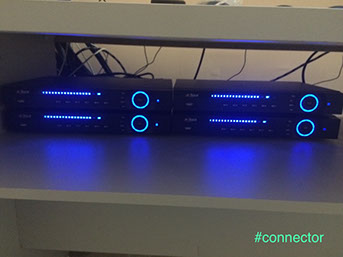
The central device of a video surveillance system is the video recorder (NVR – Network Video Recorder). As a rule, it supports 4, 8, 16, 32, 64, 128, 256, etc. channels. A video stream from one of the surveillance system’s cameras can be sent to each channel.
Manufacturers of video recorders like Hikvision and Dahua “flash” their own software at the factory, which ensures ideal compatibility of the NVR with cameras from these manufacturers. Using this software, the video surveillance system can be competently and finely tuned (video quality, frame rate, dates, etc.). These settings affect the quality of the system’s operation, the recording volume, and more. Therefore, the qualification of the engineers performing the configuration is very important.
Video recorders are supplied without HDD hard drives. The required number of HDDs and their capacity are selected for each specific project.
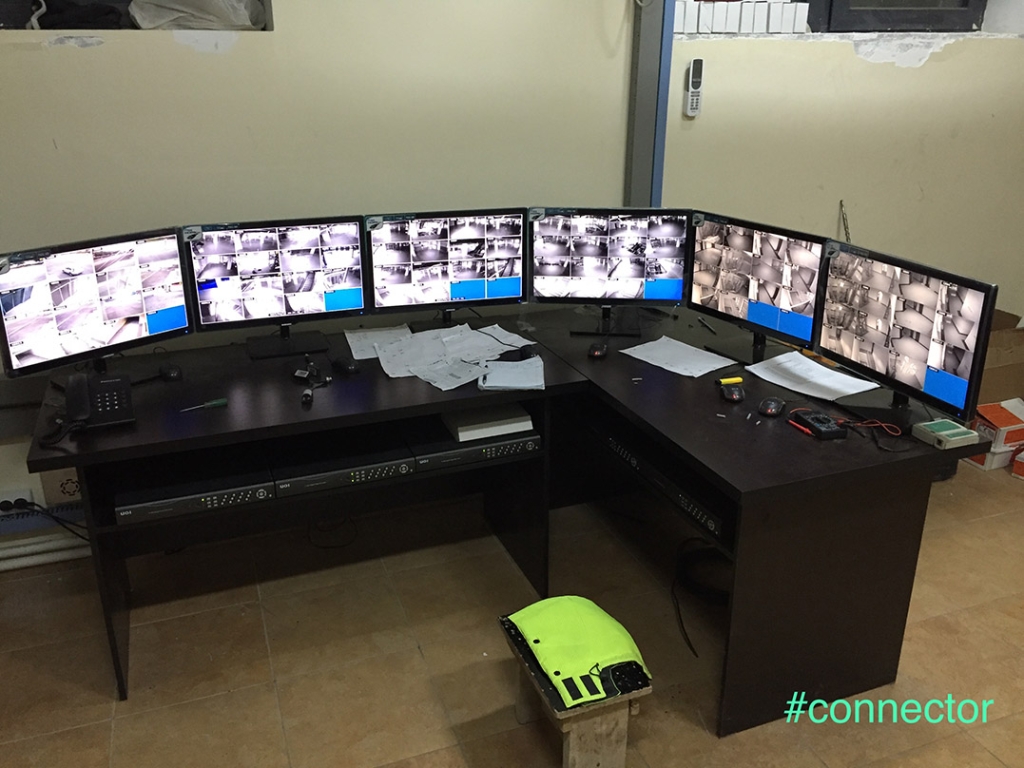
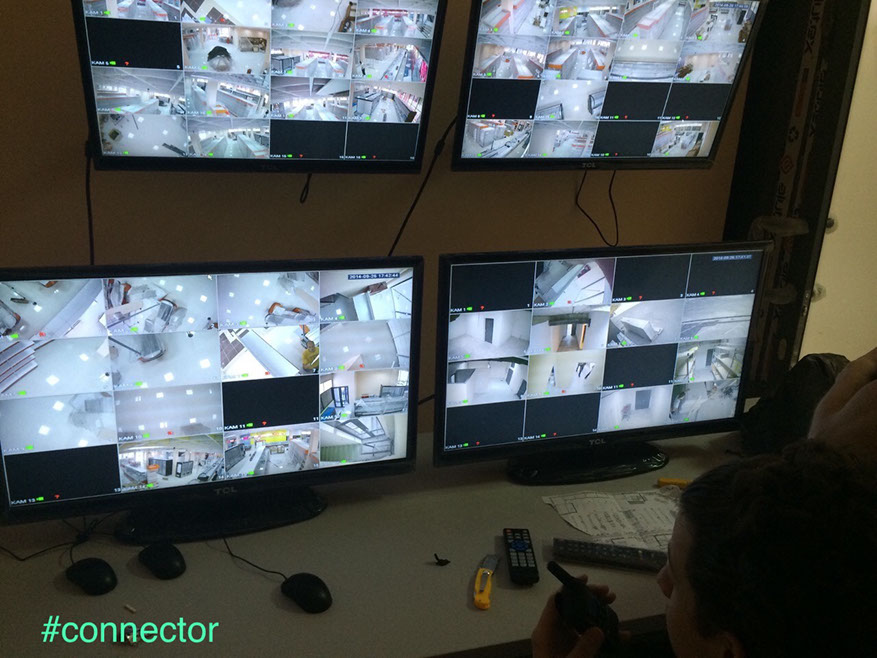
A monitor or TV is connected to the video recorder using an HDMI cable. The image from the cameras is broadcast in real-time. The larger and better the monitor/TV, the better the image quality and the ability to see recording details.
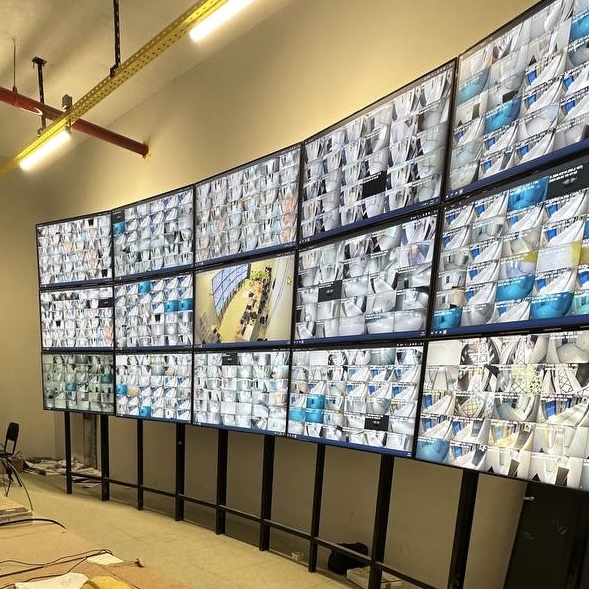
To connect a large number of monitors or video walls, additional equipment called decoders (sometimes called quad splitters) is used. Usually, such equipment is selected individually for each project.
NVR management by an operator is carried out using a standard USB mouse or a special controller (joystick). With their help, one can select cameras, control zoom, focus, and other functions. A mouse is sufficient for regular cameras, while a joystick is more convenient in some cases for PTZ cameras.
The software of modern NVRs already includes Artificial Intelligence (AI) functions, which significantly expand the capabilities of video surveillance systems:
- Facial recognition: identification of employees, visitors, or unauthorized individuals.
- License plate recognition (LPR/ANPR): automatic control of vehicle entry and exit. We will provide more details on this below.
- Object classification: distinguishing between people, vehicles, and animals, which reduces the number of false alarms.
- Detection of suspicious activities: abandoned objects, crossing virtual lines, or intrusion into a protected zone.
- People counting and flow analysis: useful for shopping centers, offices, and events.
- Predictive analytics: forecasting potential threats based on behavior.
Practically all modern video surveillance systems offer the possibility of remote viewing from anywhere in the world where there is Internet access via a smartphone, tablet, laptop, or computer. Our engineers will configure your devices considering either dynamic or static IP addresses.
For local camera viewing, additional operator workstations can be organized with supplementary NVRs, TVs, and other equipment.
Video servers
For complex video surveillance systems, in some cases, it is advisable to use specialized video servers. Video servers are, in essence, powerful computers hardware- and software-configured specifically to solve particular tasks. Our engineers select such equipment individually for each specific project.
Pros:
- High performance, support for hundreds of cameras.
- Flexibility: can be integrated with other systems (ACS, IoT, analytics).
- Advanced video analytics and AI integration capabilities.
- Scalability: easy to increase resources (disks, memory, processors).
Cons:
- Higher cost of equipment and licenses.
- Requires qualified maintenance.
- More complex to configure compared to an NVR.
Switching equipment
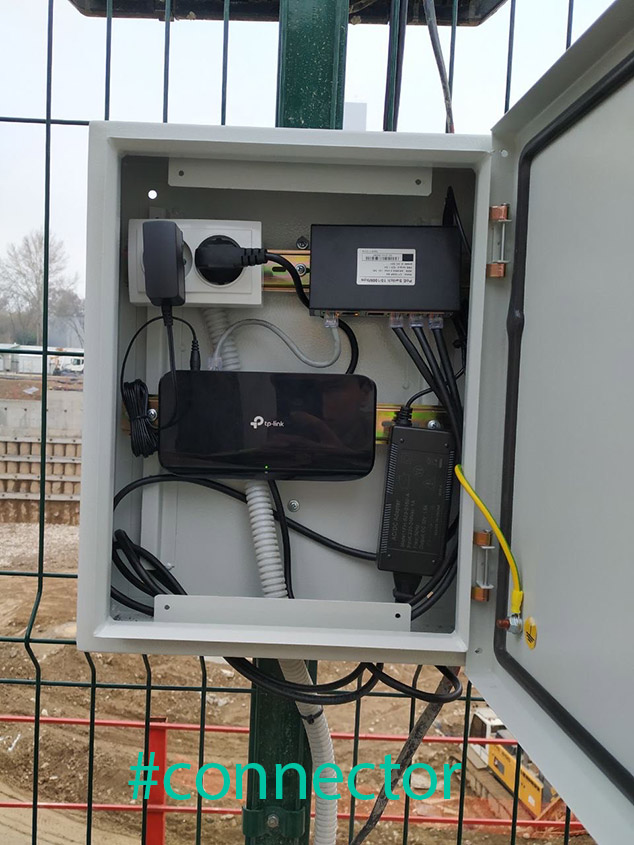
In video surveillance systems, switching is performed using standard UTP or FTP cables. More details about the types of cables for video surveillance systems and local area networks (LAN) can be found here. Cameras are connected to NVRs/Video servers via switches. In addition to transmitting video data streams, these switches provide power to the cameras using PoE technology.
PoE (Power over Ethernet) is a technology that allows both power and data to be transmitted over a single network cable.
Many installers use the most budget-friendly PoE switches to keep the project price attractively low. However, we recommend using managed PoE switches. A managed switch provides protection against network loops, allows for optimal network configuration for better performance quality, and supports remote rebooting of ports and cameras. As a rule, such switches have a faster switching matrix, which also has a positive effect on the performance quality of the entire system.
Advantages of working with us
- Quality assurance of the work performed by our professional specialists.
- Use of high-quality materials for installation. Warranty on the equipment used during installation work.
- Professional consultations before and after installation. Our specialists will help you select the optimal solution based on your tasks and budget.
- Prompt execution of installation work. We are interested in completing the work within the minimum reasonable timeframe.
- Comprehensive technical equipment for our technical staff (see Company Structure), including transport, instruments, tools, uniforms, ladders/scaffolding, and other inventory.
Cooperation process
For your convenience, we have streamlined the process of ordering video surveillance installation:
- Send a request or contact our manager by phone or Telegram at +998 98 365-93-25.
- Receive a consultation on how these works can be performed. We will help with the selection of equipment (brands, specifications, quantity, etc.).
- Coordinate the necessity of a site visit by installers for an accurate calculation of materials and labor. You will need to provide the object’s geolocation, a contact person on-site, and the meeting time.
- Coordinate the necessity of creating design and estimate documentation (DED). As a rule, DED is not required for small installation works. For large-scale installation projects, creating design and estimate documentation is necessary (see more details in the Design section).
- Receive a commercial proposal and estimate for the installation work.
- After approval of the commercial proposal, receive a contract for payment in electronic form via Didox.
- After payment, our technical department staff will travel to the site to carry out the installation work.
- Upon completion of the installation, the invoice and certificate of completion are signed in electronic form via Didox.
- Further technical support and assistance in the operation of the installed video surveillance system are available under a maintenance contract (see IT Maintenance).
Licenses and permits for installation work
We hold licenses for the design, installation, repair, commissioning, and technical maintenance of data transmission networks, the construction of telecommunications networks, as well as the installation of fire and security alarm systems and video surveillance.
All materials and equipment are supplied directly from official distributors, major suppliers, and manufacturers.
Our experience is the key to your success!
Tens of organizations in Uzbekistan trust us, choosing us as their reliable contractor for IT system installations. You can read our clients’ reviews here.


