Services
Public address and room sound reinforcement systems
Public address and room sound reinforcement systems are also called transmission systems. This is because providing sound reproduction for large spaces is only possible with a large number of relatively low-power loudspeakers connected to a single line. The transmission will run along this line to all loudspeakers.
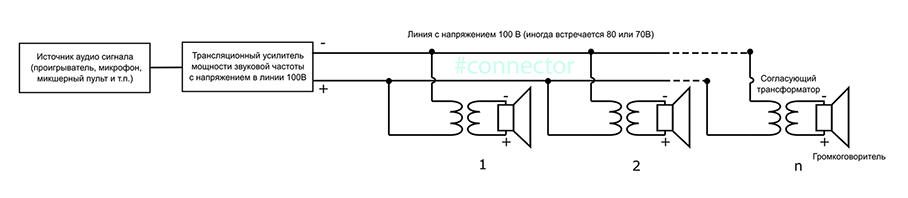
Transmission systems have their own specific characteristics, the main one being the prevention of audio signal power loss along the line. For this purpose, a wired line is used which, in addition to the main audio signal, carries an electrical signal with a voltage of 100 Volts (sometimes 80, 70, or even 50 Volts are encountered). If you connect a loudspeaker (driver) directly to such a line, it may simply burn out without producing any sound. Therefore, a matching transformer is installed before each loudspeaker. Usually, it comes included with every transmission loudspeaker. For the consumer, it is only important to understand that a public address (sound reinforcement) system must consist of a special amplifier and special loudspeakers. That is, not just any kind, but specific ones.
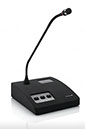
The circuit diagram shows the method of connecting the main components of a transmission system. Here, the sound source can be any player, turntable, radio receiver, personal computer, laptop, as well as a microphone or even a mixing console, to which, in turn, many microphones and players can be connected. A transmission audio power amplifier (UMZCH) can have several inputs with a selector and one or more 100 (80/70/50) Volt lines at the output. The main characteristic of a power amplifier is its wattage. Usually, it is 30, 50, 80, 100, 200, or 500 Watts. Very simply put, one can estimate that a 100-Watt amplifier will be able to power ten 10-Watt (10W) speakers. However, power drops occur on the lines and transformers, so the selection of the power amplifier and loudspeakers is best left to professionals.
Schematic diagram of a transmission system
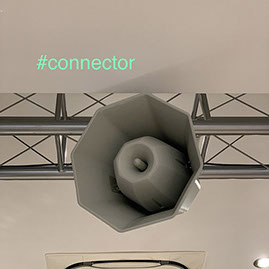
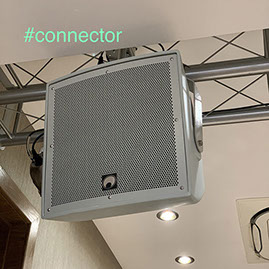
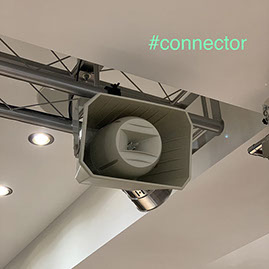
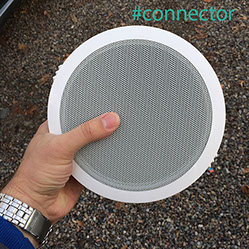
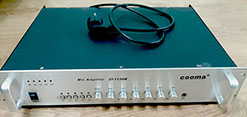
Now we will tell you about what is available on the Uzbekistan market. As a rule, our industry colleagues (and competitors) most often use cheap Chinese amplifiers and speakers of mediocre quality for installations. You can examine them in the photographs. A system built on these kinds of components will work and provide sound, provided, of course, that there are competent engineers and experienced installers. We perform the installation of both inexpensive equipment and premium segment components with equal quality. Our engineers have been involved in acoustics and sound reinforcement for many years, so the system calculation and component selection will be optimal.

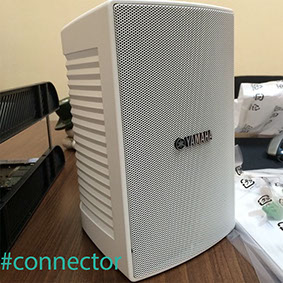
In this segment, a power amplifier may feature onboard DSP (Digital Signal Processing) for sound processing, per-channel settings, adjustable crossover frequencies, acoustic feedback suppressors, zone-based sound distribution, and many other functions. The loudspeakers are no longer just a driver with a transformer, but full-fledged acoustic systems (AS) with two-way output (HF and LF), where even ceiling speakers feature an enclosure and a bass reflex port. Designing systems with such components requires specific knowledge and experience that cannot be acquired “on the fly” in two or three years. It is better to entrust expensive equipment to professionals, and we have such experts.
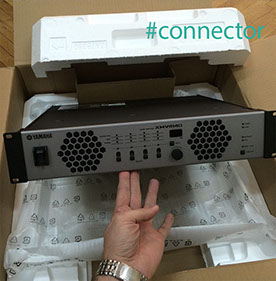
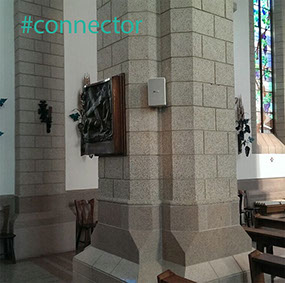
As a real-life example, we present our installation of a sound reinforcement system in the Polish Catholic Cathedral in Tashkent. Here, we used a digitally controlled transmission audio power amplifier and two-way closed-type acoustic systems from YAMAHA. This system has been operating for over 5 years without a single breakdown!
What should be done if higher quality sound is needed, when not only voice but also music needs to be broadcast? Where the presence of a bass component and clear high frequencies is desirable. Such components are produced by serious manufacturers under brands well-known in the world of sound: Yamaha, Bosch, JBL, etc.
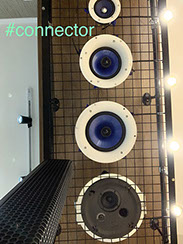
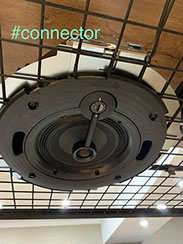
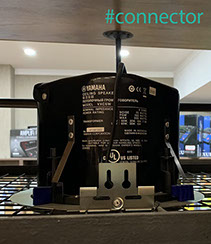
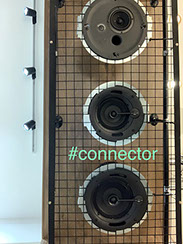

If you have decided to equip a building or another space with a public address/sound reinforcement system, the first thing to determine is the equipment class.
-
Budget, well-suited for canteens, fast-food establishments, medical clinics, schools, and other educational institutions.
-
The mid-range and premium segments can be considered as a single class. Here, the cost may vary depending on the brand, but overall, all components are of very high quality. Equipment of this class should be chosen when constructing business centers, international-class clinics, model educational institutions, important government facilities, mosques, and offices of large companies and holdings.
An error at this stage is fraught with the fact that by “pinching pennies,” the Customer—after the completion of installation, construction, and commissioning of the premises—realizes with surprise that the sound quality is not right, and after some time, equipment breakdowns begin. Meanwhile, the cabling system has already been laid, enclosed, and walled in, and the money has already been spent. After all, even a budget option costs money. Therefore, we recommend listening to our advice at this stage. For skeptics and proponents of cheapness, we offer a special article —>>
Transmission systems are not limited to indoor spaces. Open-air areas can also be provided with sound. For this purpose, special all-weather acoustics are used. For the vocal range, horn systems with high sound pressure efficiency are effective. In simple terms, they are the loudest among speakers of the same power. If a low-frequency element is required for musical tracks, there are “closed box” solutions in a special all-weather enclosure.
For all questions, you can contact our company; we will be happy to share other nuances of creating public address and sound reinforcement transmission systems.