Solutions
Connecting enterprise branches via VPN
Modern enterprises with geographically distributed branches face the need to organize a unified information environment. Company management strives to provide employees with access to corporate resources regardless of their geographical location, which allows for increased work efficiency, simplified control, and unified security standards.
Objectives of Unification
- Unified access to resources: employees gain the ability to work with corporate applications and databases as if they were in the same office.
- Centralized management: administrators control the infrastructure from a single center, which reduces support costs.
- Increased security: a unified access policy and data encryption.
- Reduction of operating costs: eliminating the duplication of services in each branch.
One of the widely used technological solutions to this problem is the use of VPN tunnels. Utilizing IPsec or SSL-VPN allows for the creation of secure communication channels between branches over the Internet.
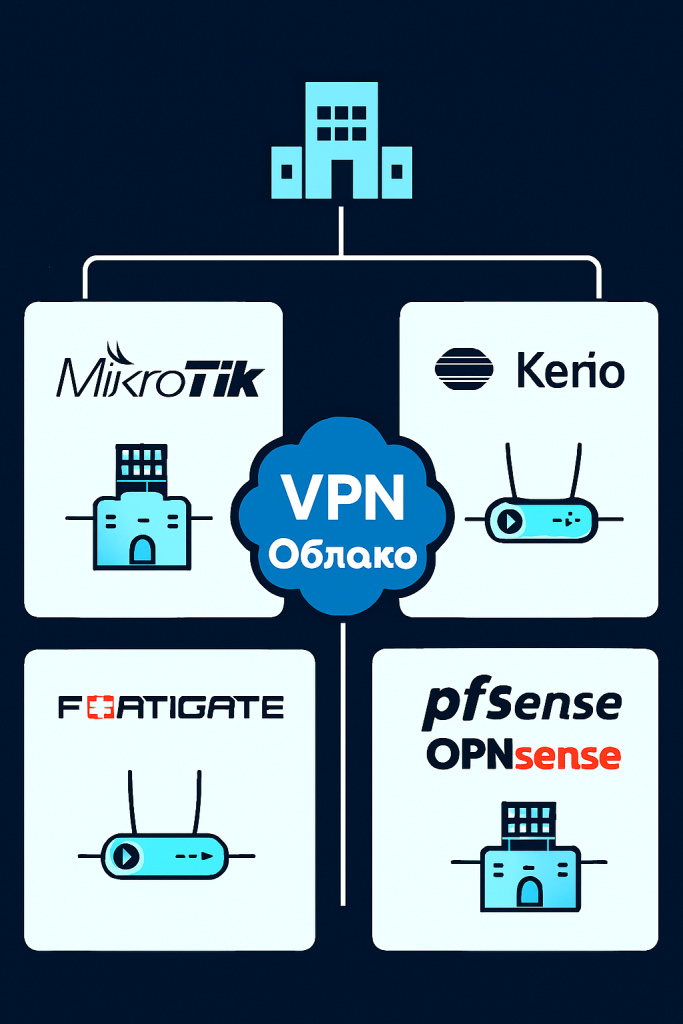
To connect enterprise branches via VPN, different solutions can be used depending on the tasks. This can be achieved using:
- MikroTik hardware and software
- Kerio Control software (and sometimes hardware)
- FortiGate hardware from Fortinet
- Specialized operating systems based on FreeBSD
Each option has its own characteristics, but in general, it refers to building a site-to-site VPN (IPsec or OpenVPN) so that branches operate as a single network.
MikroTik
- Supports IPsec, L2TP/IPsec, OpenVPN, GRE.
- Flexible configuration via Winbox (MikroTik’s native software) or CLI.
- Allows for building hub-and-spoke (central office ↔ branches) or full-mesh (everyone with everyone) topologies.
- Example: On MikroTik, an IPsec peer, policy, and identity are created for each branch.
- Well-suited for organizations with a large number of branches, such as pharmacy chains or retail networks. This is because the solution is relatively inexpensive, and MikroTik, when configured correctly, can operate for a long time without maintenance.

Kerio Control
- Supports IPsec VPN and its proprietary Kerio VPN Client.
- Flexible configuration via a web interface.
- Extensive functionality and intuitive analytics.
- VPN tunnels can be organized from Kerio Control in the head office with MikroTik in branches (or other equipment, or another Kerio Control).
- A mid-priced solution.
- Convenient for medium-sized companies, especially where user internet control is required.

FortiGate
- Supports IPsec VPN (IKEv1/v2) and SSL VPN.
- There are built-in tools for monitoring and centralized management.
- IPsec configuration with MikroTik is possible (via IKEv2).
- Often serves as the corporate standard.
- Quite expensive. Requires periodic license purchases.
- Well-suited for large organizations with extensive networks.

pfSense / OPNsense
- Protocol support: IPsec (IKEv1/v2), OpenVPN, WireGuard.
- Flexibility: can be deployed on both “bare metal” and in virtual environments (VMware, Hyper‑V, Proxmox).
- Scalability: suitable for both small businesses and large networks.
- Management: user-friendly web interface, plus a huge community and documentation.
- Feature: easily integrates with other solutions (for example, you can connect a branch on MikroTik with a central office on pfSense via IPsec).
- Cost: the system itself is free; only a physical or virtual server is required.
- Requires qualified maintenance.

Our specialists will help you choose the most suitable option for your organization. Following that, we can implement any of these solutions and provide qualified technical maintenance moving forward.